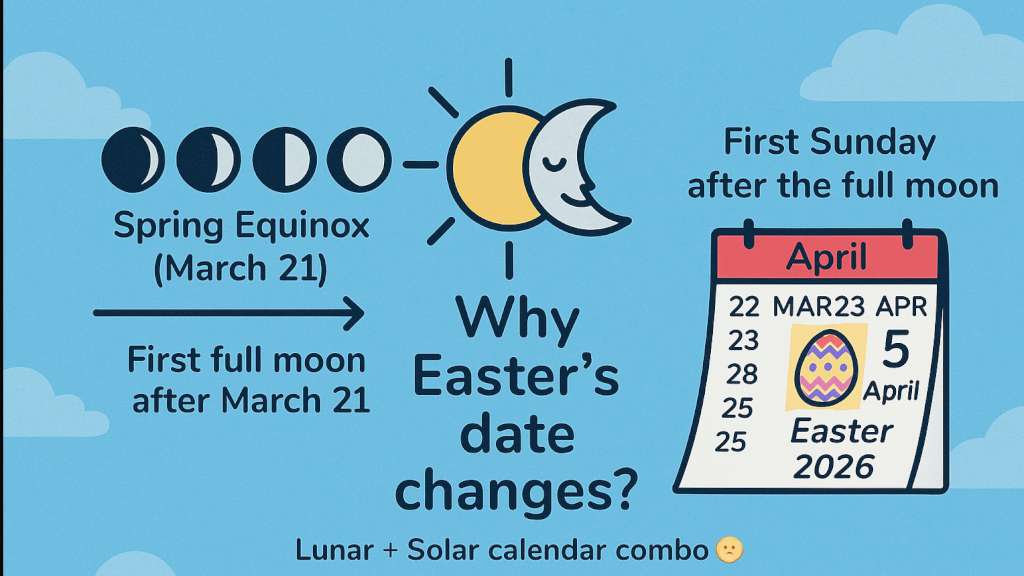
Church bells ringing, families crowded around the dinner table, chocolate everywhere, Easter really does have all those cozy, comforting moments. But here’s the thing: trying to figure out when Easter actually is each year? It genuinely feels like a puzzle. When you’re starting to plan stuff for 2026, it makes sense to wonder what date Easter will be. The answer really boils down to how the moon moves and what ancient calendars were based on. Our everyday calendar follows the sun, but Easter’s date is actually determined by both the sun and the moon. It works like this: the spring equinox (typically March 20) comes first, then you look for the first full moon after that.
Those two things are what determine when Easter falls. Christian tradition says Easter is the first Sunday after Passover, which itself is based on when the full moon occurs. That’s why Easter ends up on a different date every single year.
So what does that actually mean for 2026?
Let’s work through it: on March 20, 2026 (a Friday), we have the spring equinox. The church figures the next full moon after that will roll around on Thursday, April 2, 2026. And the first Sunday after that full moon? April 5, 2026. So for most Western Christians, Catholics and Protestants, Easter in 2026 will be on April 5. That’s actually pretty early for Easter, some years it doesn’t happen until late April. This early date will have a domino effect on school schedules, travel plans, and store promotions. You’ll probably start seeing Easter stuff on store shelves by late March.
Eastern Orthodox Church
Now, if you’re looking at the Eastern Orthodox Church, things are different. They still use the Julian calendar to figure out Easter, which means their spring equinox and full moon dates end up being days or even weeks off from ours. Orthodox Christians will celebrate Easter a week later, on Sunday, April 12. In countries with lots of Orthodox Christians, Turkey, Greece, Russia, Easter celebrations will actually happen over two different weekends In 2026. In Istanbul, for instance, the Hagia Sophia and the Ecumenical Patriarchate will have their Easter services on a totally different weekend than the Catholic churches in Sultanahmet. It shows off the area’s incredible cultural mix, but it definitely makes planning complicated!
There’s something really profound about how this date keeps shifting, it shows the tension between our neat, synthetic calendars and the way nature actually works. We’re so used to dividing the year into neat months and days, but Easter, which is tied to these ancient natural cycles, throws that whole system off. So April 5, 2026 isn’t just another date, it’s where centuries of tradition, the stars, and history all come together. Sure, write it down for your calendar, but it’s also a nice reminder of how everything, the seasons, the sky, what we believe in, all intertwines. At the end of the day, a date is never just a number, it carries all kinds of stories and weight. This spring, no matter where you are or which tradition you follow, Easter can be a time to celebrate renewal, continuity, and the natural flow of things.
How will Easter play out in 2026?
On Sunday, April 5, 2026, churches all over the Western Christian world will be filled with people, and those bells will be ringing with the message of resurrection. With Easter coming earlier than usual, though, people might feel a little rushed getting everything ready. Spring won’t be in full swing yet, especially up north, so if you’re planning outdoor services or egg hunts, you’ll definitely want a backup plan for rain. By late March, store shelves will be loaded with pastel decorations, chocolate bunnies, and tons of tulips. For the travel industry, an early Easter is actually good news, people will book vacations earlier, and flight prices will probably go up during that time.
But for people following the Eastern Orthodox tradition, the story’s different: they’ll be celebrating on Sunday, April 12, 2026. That one-week gap creates an interesting dynamic in cities like Istanbul that bring together different cultures.
Why does Easter’s date change every year?
Easter falls on a different date each year because early Christians tried to align the holiday with the cycles of the sun and moon. Church leaders gathered at the Council of Nicaea in 325 AD and came up with a rule that’s still used today: Easter is celebrated on the first Sunday after the first full moon that occurs after the spring equinox, which they set as March 21. But here’s the thing, the sun and moon don’t actually follow a schedule that matches up with our calendar. Think of it like trying to sync two different clocks, one tracking the sun, one tracking the moon, they just won’t chime together.
A solar year is about 365 days, but 12 lunar months only come to around 354 days. That 11-day gap pushes the spring full moon earlier each year, which means Easter shifts around too. Pope Gregory XIII shook things up in 1582 when he reformed the calendar to correct a 10-day gap that had built up in the Julian calendar.
Eastern Orthodox churches never adopted this change and still use the Julian calendar method. So for them, “March 21” sometimes falls into early April on our calendar. It’s not just some random calendar thing, it actually highlights how we struggle between sticking with tradition and getting things scientifically right. Easter bounces around the calendar because it’s trying to balance what nature does with what the church believes. You can’t pin down resurrection to a single fixed day, but we keep looking up at the sky to figure out when to celebrate it. In some sense, Easter’s meaning transcends whatever calendar we’re using. What’s the exact date for Easter in 2026?
When is Easter in 2026?
Good question. Unlike holidays that stick to one date, Easter moves around every year. That’s because Easter’s date is based on an old tradition and astronomy, it’s celebrated on the first Sunday after the first full moon that comes after the spring equinox. For Western Christians, whether Catholic or Protestant, Easter’s date is based on the equinox falling on March 20 or 21, even though the actual astronomical equinox can shift by a day or two. After that full moon appears, the next Sunday is Easter. This system dates back to 325 AD when a major church council set it up, and it’s been the same ever since.
So what does that mean for 2026?
In 2026, the spring equinox falls on March 20. The first full moon after that comes on April 2, which means Easter Sunday is April 5, 2026. That’s when you’ll see all the egg hunts, chocolate bunnies, and Easter brunches. But here’s the thing: not every Christian celebrates Easter on the same day.
Eastern Orthodox churches typically stick with the older Julian calendar, which often puts their Easter weeks later. In 2026, the calendars actually sync up, so Western and Orthodox Christians will both celebrate Easter in early April, it’s pretty neat when that happens! Sometimes it works out that way, and everyone gets to celebrate at the same time.
You might think calculating Easter’s date would be straightforward, but it’s actually been a source of major debate throughout history. Some people have suggested just picking a fixed Sunday in April to simplify things. For now though, we’re still sticking with the old ways and going by what we see in the sky. So if you’re organizing a family get-together or just wondering how these things work, remember that tradition and the stars will decide when Easter happens in 2026. If you’re traveling in April, keep in mind that some states have local events or school breaks that might line up with Easter. No matter where you end up on April 5, you’ll find the same pastel colors and sweet treats everywhere. Happy Easter!
Why does Easter’s date change every year, unlike fixed holidays?
The main reason Easter bounces around is that it’s tied to both the moon and the sun. Once you throw the moon into the mix, you can’t have a fixed date. Here’s the deal:
Easter celebrates the resurrection of Jesus in Christianity. When church leaders decided on the date, they wanted it to sync with Passover, the Jewish festival that’s based on the full moon. So back in the 4th century, they decided at a council that Easter would be the first Sunday after the first full moon following.
How does the spring equinox determine the date for Western Easter?
Think of the spring equinox as the starting line for Easter’s date. Around March 21st each year, the sun crosses the equator, which means day and night are almost the same length. Back in the 4th century, the church established a rule: Easter falls on the first Sunday after the first full moon that comes after the spring equinox. Here’s how it actually works:
Begin on March 21st. Then look for the next full moon after that date. Whichever Sunday comes next, that’s Easter. That’s why Easter bounces all over the calendar, it can fall anywhere from March 22 to April 25 depending on the lunar cycle. And here’s where it gets interesting: Western churches follow the Gregorian calendar while Orthodox churches use the Julian calendar, so they can even disagree on when the equinox happens, which means some years we end up celebrating Easter twice!