
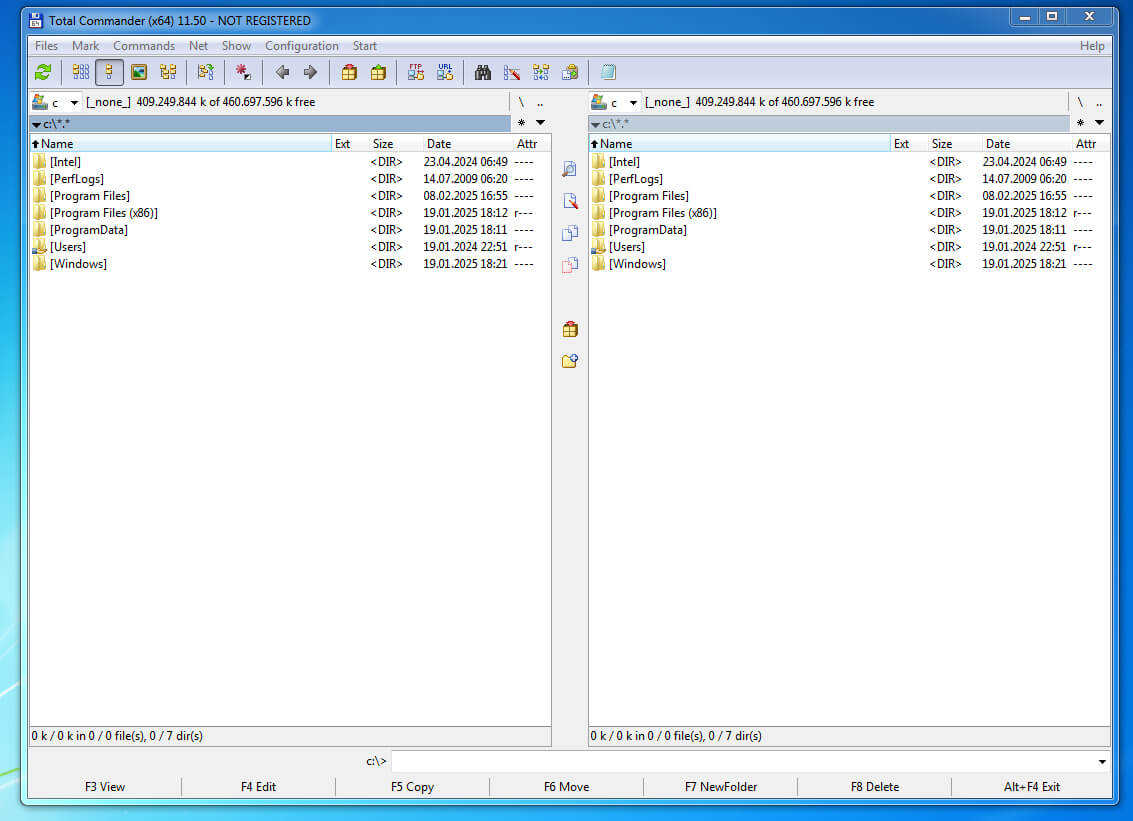
If you’ve ever used a Windows PC to copy a huge folder from one drive to another and ended up staring at that little hourglass icon spin uselessly, then you probably know the one thing you wished could happen is to skip it all. Well, Total Commander is more or less the application that was specifically designed to handle just such a situation, and has been doing so for longer than most people had ever heard of file managers.
It appears that intuit- oh sorry, wrong article. Let me try that again. Christian Ghisler has officially launched version 11.50 of Total Commander, which comes under the banner of their 2025 line, meaning you can go to their website and download the whole package right away. So if you’ve been waiting for the release, there you have it and if you haven’t heard about Total Commander, you are in for a treat, keep on reading: by the end of this, chances are you will want to try it.
So what exactly is Total Commander?
Most users over the age of 30 may recall the days before 2002 when this program was known as Windows Commander. Unfortunately (in the eyes of the developer), Microsoft got involved, and the name had to be changed for some obscure legal reason (and they are quite right in this one), and the name became Total Commander.
The program was developed using Delphi and since its creation, it’s always been improved upon. If you’ve never heard of it, and you’re over 30, now you have. Total Commander is a shareware program that you can try out free for thirty days, but after the thirty-day evaluation period is up, you have to register the program to keep using it without all of its features locked. Registration of this program is relatively cheap, so please save yourselves and avoid the shady warez sites searching for a cracked version. But, let’s get on to where you can download this utility.
System Requirements
I’ll skip a processor & RAM table for this because honestly, Total Commander is not really that type of program. However, what you should know is that it works on Windows 95, 98, ME, NT 3.51/4.0, 2000, XP, Vista, 7, 8, 8.1, 10 and 11. That basically includes any Windows based computer you are going to be running into. If the computer runs on Windows, Total Commander should be fine on it. And there’s not really much more that can be said about the system requirements.
What’s new for Total Commander 2025 (v11.50)?
Well, to be honest, not a whole lot. For one thing, the interface has been completely left untouched. In other words, it still looks like it belongs to Windows XP and if anything, it looks like it’s not being updated either, something I pointed out in the installation stage and feel like I need to bring up again because this is what new users usually notice first.
However, if the question is “did anything change in the program itself” than the answer is yes, kind of. There are a few updates in file transfer, updates in multi-language support, updates to the file comparison done by the built-in editor, synchronization updates, and a couple of buttons that were added more easily accessible on the tab bar. None of this is really major, though.
Honestly, I’m not wowed about this new 2025 release, and didn’t really expect to be. The point of this program is moving files reliably and fast and if the program can do that in a stable way than that is basically all that it needs to do and exactly why Total Commander is still relevant after all of these years.
| Features | Free Version | Pro |
|---|---|---|
| Basic file management | ✓ | ✓ |
| Dual window mode | ✓ | ✓ |
| Portable version | ✓ | ✓ |
| FTP and SFTP support | ✓ | ✓ |
| ZIP and other archive formats | ✓ | ✓ |
| Plugin support | ✓ | ✓ |
| USB version (no installation required) | ✓ | ✓ |
| Screenshots | – | ✓ |
| Shortcut keys customization | ✓ | ✓ |
| Advanced customization options | – | ✓ |
| Licensed updates | – | ✓ |
| Dedicated support and customer service | – | ✓ |
| Multi-color version (color inputs) | – | ✓ |
| Mac and Linux support | – | ✓ |
| Backup and restore tools | – | ✓ |
| Premium add-ons and mods | – | ✓ |
What does Total Commander really do?
The program itself will be appealing to those who frequently copy, move, or transfer information between locations or devices. Even those that don’t often work this way, though, can find it useful when, say, downloading a large movie or game, transferring big files between drives, getting files from a phone onto a computer (and vice versa), or extracting a ZIP file with one folder while copying a file at the same time. For any of these actions Total Commander is noticeably faster than Windows Explorer.
Have you ever had this happen on Windows? While accessing folders on the C: drive, especially, you are forced to wait before the file view even comes up. This is due to Windows indexing its directories and looking for potential threats to system stability which requires the system a moment. You stare at the hourglass/spinning cursor and wonder if you system is sluggish. If you’re on a fairly new system, you probably aren’t-every system has this delay. It is just how Windows works. Total Commander skips much of this. It accesses the folder, immediately regardless of whether the files are large or in the deepest folder.
So for example if you are formatting your drive, downloading from your phone, or accessing a remote machine through an FTP client, the files are transferred quickly and also safely, so that they aren’t corrupted should there be an interruption-this alone makes it worthwhile for years of use.
How do I download Total Commander?
Before I explain the download I would just like to point out that there is no need to visit any third party site to download a full version of the software because the trial version is fully functioning for thirty days (and the full version is also sold at an affordable price).
To download the 2025 edition (version 11.50) you have to visit the home page of the Total Commander program which can be found at ghisler.com. You may download the software in either 32-bit or 64-bit; because most systems running nowadays are 64-bit I recommend that you download the 64-bit version if your operating system allows. The download file should be about 6.7 MB (if the downloaded file is of roughly this size than that means you have downloaded the right version). You can download from alternate download sites listed but I recommend using the main download source from the homepage.
How do you install Total Commander?
The installer is reminiscent of older WindowsXP installations with a simple dialog on a blue background with not much else. All you need to do is:
Run the installer, choose your language and press next. The default location is C:\Program Files\totalcmd, which is perfectly adequate for virtually anyone. Press next a couple more times and OK. This takes about a minute and installs no unnecessary additional programs, toolbars, or similar elements.
These were the Windows instructions as I installed it for the PC version but it really could be any older or current Windows system. For the Android version it is a case of simply downloading it off the Google Play Store – you do not need to download the APK file unless you so desire to do so and it is available to download from a ‘Mobile‘ section on their official website.
Just so you know, you can install it onto the following systems: Windows 95, 98, ME, 2000, NT, XP, Vista, 7, 8, 8.1, 10, 11, and Android. The installable versions are not available for any other operating systems.
So how do you use the thing then?
On opening the program you are met with a “version” window telling you the version is, in large letters, 11.50, there’s some registration/licencing info and a (slightly annoying) selection of number buttons from 1 through 3. You need to click whichever number the screen is telling you to click. For me it was 3 and it popped up saying press the number 3 and so I did and got through the menu. You can’t just skip this window, you need to click on whatever number it is asking for.
When this has been done a configuration window opens. In this window you can tweak and adjust various settings, but the default options seem to be alright so you shouldn’t really need to tweak very much here at all. Any option that you might want to look at the settings for, they are covered in the help file that comes with the program. I don’t really think I need to go through every single one in detail here – I would prefer to give you the gist of the differences from previous versions.
What I did notice was how practical the file transfer window seemed. It has the folder trees top and bottom and that helps you get where you want to go quickly; as there’s no waiting around when you want to open a folder, it just opens. I thought that was well worth changing for. The program was already fast before, but seeing the entire directory tree within the transfer and destination panel is good. Drag and drop also seemed fairly good in the transfer window.
The program really doesn’t take any major technical know-how to use. The main purpose is really just to move stuff from one spot to the other. The left window shows you the file or directory that you want to move to the panel on the right, where it will end up when you send it over by simply picking and sending or drag and drop it over to the destination screen. Other than that there really isn’t too much that needs to be done on the program with the other windows/menus, besides the configuration and transfers, etc. It may take the more casual user a minute or two to find out how to utilize the menu to setup the transfers if they want to utilize the FTP functions, but I think those who utilize the FTP features of the program will most likely know their way around without any issues at all.
Within minutes the average person will be able to figure out what is going on with the program just by playing around with the menus. Having a general grasp of the English language would be nice, as there are apparently about 10 different languages that you can change the language within the program to, but, it is all visual enough that no one will be lost any more than any other program they might download.
It is: Drag it. Drop it. Done. This is Total Commander.