

Advanced Data Encryption and Structural Drive Security
Securing digital assets requires robust architectural protocols that defend against unauthorized access, accidental modification, and data exfiltration. Folder Lock functions as an enterprise-grade security utility engineered to intercept potential system vulnerabilities by locking entire directories, individual system files, and external storage nodes. Once an object enters this restricted perimeter, the operating system denies all primary file manipulations. These security barriers stop unauthorized actors from executing deletion commands, moving assets to external directories, copying raw data streams, or altering filenames. Consequently, this multi-layered defensive framework ensures complete data integrity.
Furthermore, an advanced file-masking engine complements this operational layer by rendering sensitive records completely invisible within the Windows file architecture. This structural configuration provides comprehensive privacy by removing targets from standard directory listings. Portable storage environments frequently introduce significant data leakage vulnerabilities during transit, but this security architecture mitigates these specific vectors by extending identical cryptographic baselines to external media devices. For instance, high-capacity USB flash drives, solid-state external drives, and network-attached cloud environments receive full protection.
Additionally, direct file synchronization modules integrate natively with major cloud storage providers like Dropbox and Google Drive, establishing encrypted pipelines for remote asset management. At the core of this system is the specialized virtual storage vault framework, colloquially designated as Lockers. These virtual storage containers apply immediate 256-bit AES cryptographic protocols to all nested files in real time. As a result, this process guarantees that data remains unreadable even if the physical storage medium is compromised.
System Compatibility and Architecture Changes
The current system release integrates comprehensive optimizations tailored specifically for contemporary Windows 10 and Windows 11 ecosystems. While accommodating legacy 32-bit hardware, the operational architecture achieves peak throughput when deployed across native 64-bit systems. Moreover, this updated version incorporates cloud-native encryption layers that automatically secure digital assets prior to remote server transmissions. The baseline endpoint protection layer features a modern behavioral monitoring engine designed to detect unauthorized process requests and suspicious software signatures.
Simultaneously, access controls have expanded past standard master passwords, integrating multi-factor authentication loops alongside secure email validation and specialized smartphone authenticator apps. These structural updates operate behind a rebuilt, minimal user interface designed to streamline asset management and reduce system latency. Therefore, operators experience a much faster and more intuitive workflow during daily utilization.
Core Operational Modes and Masking Modules
- Targeted data pools remain locked against standard execution pathways to prevent accidental modification.
- Modified system rules intercept standard file system commands to inhibit unwanted deletion routines.
- Deep file hiding protocols obscure directories from Windows Explorer and low-level command prompts without altering physical block arrays.
- Virtual disk mounting maps secure storage containers to dedicated drive letters for streamlined desktop accessibility.
- Multi-layered drive locking restricts access to secondary storage volumes and external flash media excluding core system partitions.
Cryptographic Sanitation and Digital Trace Eradication
Standard operating system file deletion merely clears the directory reference index, leaving the underlying binary clusters intact on the physical platters until overwritten by subsequent operations. Specialized recovery utilities exploit this operational lag to reconstruct compromised business intelligence. Therefore, the native storage sanitation tool counters this vector by deploying rigorous data shredding algorithms that overwrite targeted sectors multiple times with randomized data matrices. This execution ensures complete destruction prior to asset disposal.
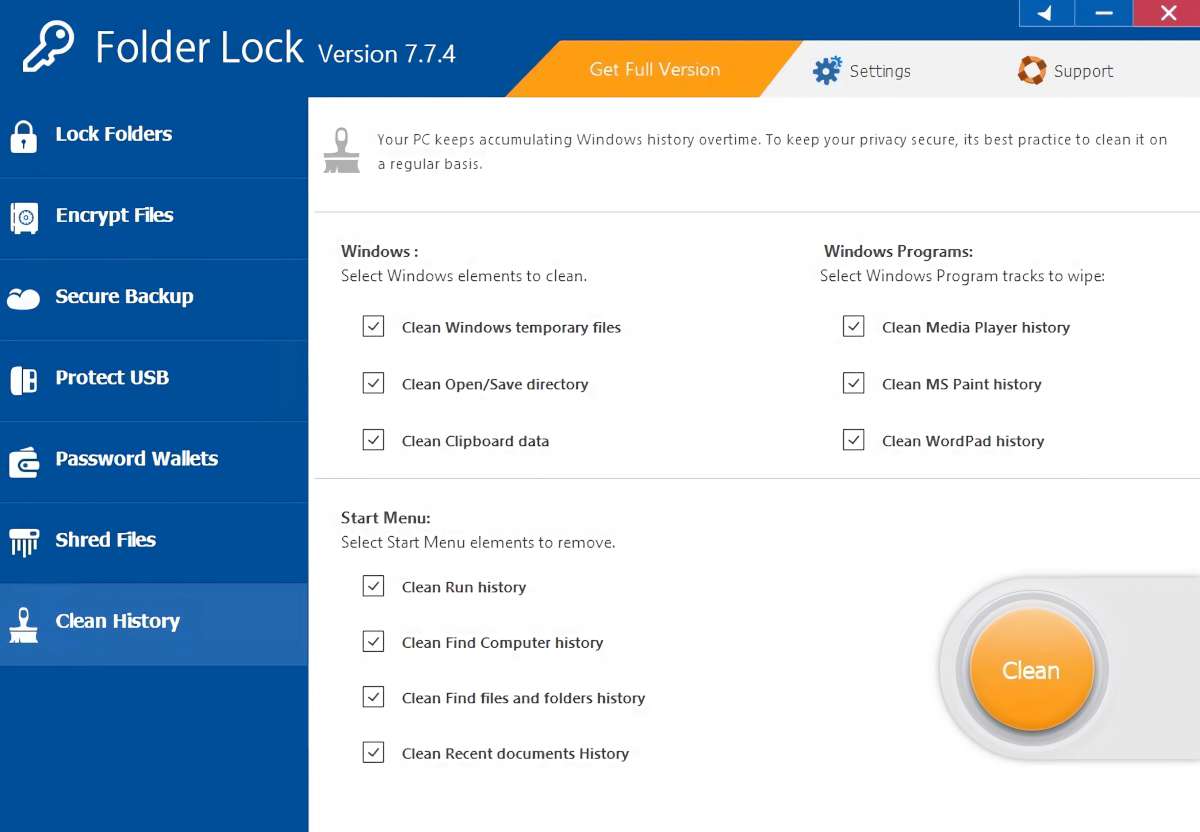
In addition, parallel privacy modules feature automated cleaning routines that target application caches, browser tracking cookies, operational histories, and temporary system logs. This continuous sanitization process removes user behavior patterns and digital footprints left across text editors, media engines, and internet browsers. Consequently, third-party operators cannot trace your past computing workflows.
Secondary Security Enhancements and Automation
Secondary operational enhancements include an isolated password vault designed to generate and store complex authentication keys for external accounts. Meanwhile, operating system transparency is maintained through an integrated stealth deployment mode that removes active processes from the Windows Start Menu, standard shortcut registries, and Task Manager diagnostics. The utility remains completely hidden until activated via a custom hardware key sequence.
Furthermore, an automated idle timeout lock monitors workstation activity, immediately sealing open virtual storage containers and active directories if the system detects prolonged user absence or screensaver initialization. This automated response shields vulnerable files when a workstation is left unattended.
Diverse Implementation Scenarios across Professional Environments
- Corporate personnel utilize the software to protect proprietary consumer databases, financial books, and trade secrets from insider threats.
- Remote freelancers secure intellectual assets, contract drafts, and operational records from shared network environments.
- Academic researchers employ the cryptographic framework to safeguard long-term study data and analytical findings from accidental deletion.
- General workstation operators leverage the isolation layer to maintain distinct personal privacy barriers on multi-user home computers.
Frequently Asked Questions
What recovery paths exist if the master credential is lost?
The internal cryptographic architecture employs strict zero-knowledge protocols, meaning authentication parameters are never mirrored to external servers. Because these credentials act as the literal key for the 256-bit AES algorithm, resetting lost keys through customer support avenues is impossible. Therefore, maintaining a redundant copy of the master password within an isolated physical location or a secondary hardware credential manager is vital to preventing permanent lockout.
Is the software executable as a portable utility on external media?
The initialization parameters include a dedicated portable configuration sequence that deploys the application directly onto external storage hardware. This structural setup enables operators to connect the flash media to any host workstation running a modern Windows operating system to manage encrypted containers immediately. Furthermore, the sequence demands no permanent host directory allocation, preserving full cryptographic protection across unfamiliar desktop environments.
How does the virtual locker mechanism manage internal data?
A virtual locker operates as an independent, encrypted file container that the host system mounts as a standard storage volume. Files moved into this environment undergo immediate programmatic translation via real-time cryptographic algorithms. Inputting the master password mounts the container for standard read-and-write operations. Conversely, closing the interface re-establishes the encrypted perimeter to secure the contents against offline extraction.
Does active background encryption cause noticeable system degradation?
The core engine utilizes minimal background system resources and runs seamlessly alongside everyday office applications. However, when transferring massive file blocks exceeding multiple gigabytes into an active locker, users may notice temporary spikes in processor utilization and disk write queues. This operational variance represents standard hardware behavior during high-density cryptographic processing and subsides immediately upon task completion.